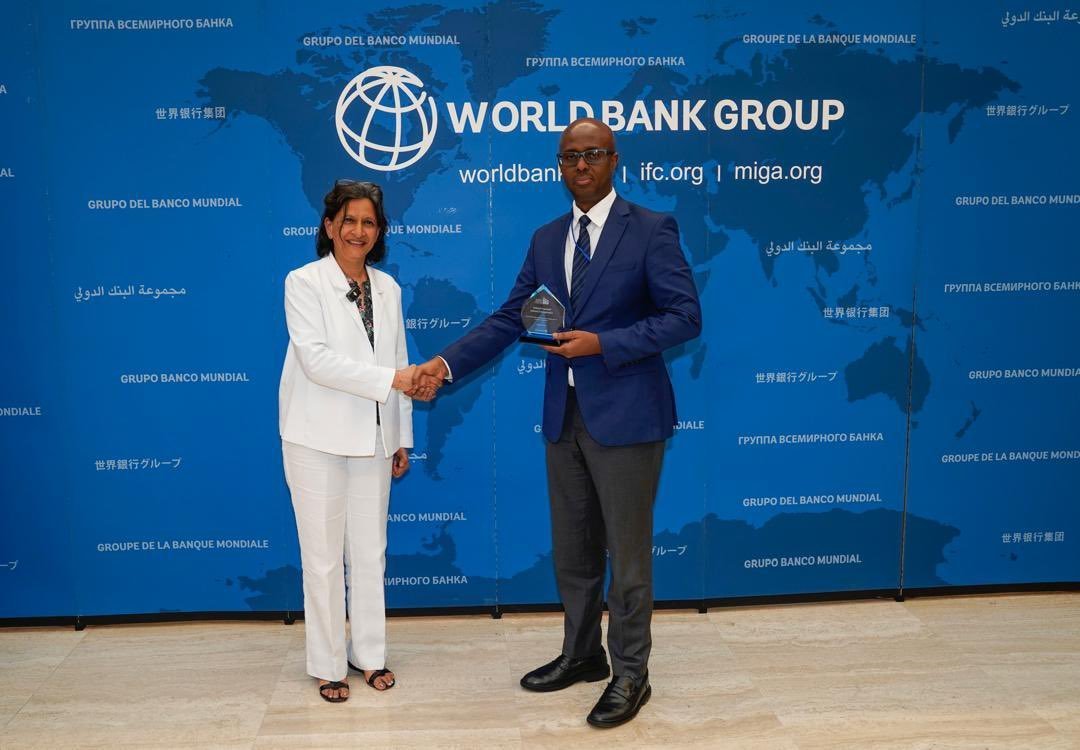
In a landmark acknowledgment that has reverberated across the corridors of international development finance, Rwanda has been formally recognised by the World Bank Group as a top performer on the newly introduced Human Capital Index Plus — known as the HCI+. The award was presented during a high-profile event held in Washington, D.C., where Rwanda distinguished itself as a standout performer relative to its income level. This recognition is not merely a badge of honour; it is a definitive validation of Rwanda's long-term, deliberate, and people-centred approach to national development — one that is fast transforming the country into a model of human capital investment for the developing world.
The significance of this achievement cannot be overstated. With an HCI+ score of 157, Rwanda has moved well ahead of the average for Sub-Saharan Africa, which stands at 126, and the average for other low-income nations, which sits at 116. These figures speak volumes about Rwanda's extraordinary trajectory — a nation that has, within a single generation, engineered one of the most remarkable human development turnarounds in modern history.
What Is the Human Capital Index Plus?
To fully appreciate the weight of this recognition, it is important to understand what the HCI+ measures and why it matters. The Human Capital Index, a globally respected yardstick developed by the World Bank Group, is fundamentally a predictive instrument. It estimates how productive a child born today will be by the time they reach adulthood, based on their access to quality healthcare and education. The index measures how much capital each country loses through lack of education and health, with scores ranging from zero to one, where one signifies that maximum potential is fully realised.
The expanded version — the HCI+ — goes further by tracking what happens to human capital across the full arc of a person's working life, incorporating employment outcomes and the quality of jobs available in the economy. It is, in essence, the most comprehensive global measure of how effectively a nation converts its investment in people into tangible, lasting prosperity. That Rwanda ranks among the world's top performers on this index is a testament not to luck or circumstance, but to sustained, strategic policy commitment at the highest levels of government.
A Recognition Built on Decades of Investment
The accolade was formally presented by Mamta Murthi, Vice President of the World Bank Group, who commended Rwanda's results-driven approach to human capital development. In her remarks, Murthi observed that Rwanda's performance demonstrates how sustained investments in health, education, and skills can translate into real productivity gains — and that it stands as a compelling example of how countries can achieve impactful results even within the constraints of limited resources.
A government representative at the event welcomed the recognition, noting that the award affirms Rwanda's long-standing commitment to placing people at the centre of national development. This philosophy — that the citizen is both the means and the end of development — has been the quiet engine powering Rwanda's ascent on the global stage.
Health as the Bedrock of Prosperity
No discussion of Rwanda's human capital success is complete without acknowledging the transformative role of universal health coverage. Rwanda's pioneering commitment to universal health coverage through the Mutuelle de Santé community-based health insurance scheme has provided affordable care to over 90% of the population, effectively removing the devastating fear of medical debt from millions of households. This is not a minor administrative achievement — it is a foundational act of social solidarity that has unlocked the productive potential of an entire nation.
The results are measurable and striking. Rwanda has recorded a 79% survival rate to age 60 and has made massive strides in reducing childhood stunting — a condition that, if left unaddressed, permanently diminishes cognitive development and lifetime earning potential. By protecting children from the earliest stages of life, Rwanda has ensured that the investments made in education and skills development are not undermined by poor health outcomes.
Education, Skills, and the Architecture of a Modern Workforce
Rwanda's approach to education has been equally visionary. Rather than treating schooling as a mere exercise in enrolment numbers, the government has pursued a relentless focus on learning quality and curriculum relevance. Rwandan students currently outperform most of the region, a surge that is partly driven by the country's bold decision to invite world-class international institutions — among them Carnegie Mellon University Africa, the African Leadership University, and the University of Global Health Equity — to establish operations in Rwanda. This has raised the academic bar domestically while simultaneously attracting regional talent and international faculty to the country.
Complementing academic excellence is a strong and expanding Technical and Vocational Education and Training (TVET) ecosystem. Rwanda has moved deliberately away from informal, invisible labour by making it possible to register a business within hours and by incentivising stable, formal employment contracts. This shift is powered by a focus on technical and vocational training, ensuring that graduates enter the workforce with specific, high-demand skills that allow them to step directly into formal roles.
The dividends of this strategy are visible in the employment data. While many neighbouring countries continue to struggle with youth unemployment, 65.2% of Rwandan youth are currently in wage-based jobs — more than double the regional average. This is a remarkable statistic that reflects not just economic growth, but the quality and structure of that growth.
Technology, Digital Infrastructure, and the Economy of the Future
Rwanda's ambitions extend well beyond the present. The country has aggressively positioned Information and Communication Technology as its primary engine of future growth. By treating internet access as a basic utility rather than a luxury, Rwanda has built a robust foundation for a digital economy — one that is supported by digitalised government services and a business environment designed to attract global industry. This investor-ready climate, underpinned by a professionalized and educated workforce, creates a virtuous cycle in which economic development and human capital reinforce each other continuously.
Rwanda has also introduced social security mechanisms such as the EjoHeza long-term savings scheme, ensuring that stable employment is matched by long-term financial security for workers. This creates a culture of planning, savings, and resilience — precisely the qualities that define a productive, forward-looking citizenry.
A Model for the Continent and the World
The recognition positions Rwanda as a model for other developing nations seeking to maximise the impact of limited resources and reinforces the country's growing reputation as a leader in evidence-based, people-centred governance. For the African continent, which faces significant human capital deficits that threaten long-term growth, Rwanda's story offers a practical and replicable blueprint: invest consistently in health and education, build institutions that convert learning into employment, and never lose sight of the individual citizen as the ultimate measure of national success.
For Rwanda's business leaders, policymakers, investors, and professionals — those who sit at the intersection of public ambition and private enterprise — this World Bank recognition should carry resonance. A nation with a highly productive, healthy, and skilled workforce is a nation with a competitive economy, an attractive investment climate, and a stable social fabric. Rwanda is demonstrating, in real time, that these outcomes are achievable — and that they are worth every franc invested.
The numbers behind the headlines
While Rwanda is being celebrated on the global stage, poverty at the household level remains deeply stubborn. Rwanda's poverty rate has fallen from around 39.8% in 2017 to 27.4% in 2024 — progress that is real, but that growth has been largely driven by public investment supported by external aid, and has not yet translated into rapid, broad-based productivity gains. That means millions of ordinary Rwandans are still being left behind by the very growth story being applauded internationally.
Rwanda has been creating roughly 217,000 jobs per year since 2019, but most of those new jobs remain informal, low-paid, and lack stability or social security — especially for youth and rural workers. For someone farming a small plot in the Southern Province or selling goods by the roadside in a rural district, a top ranking on a World Bank index does not put food on the table tonight.
What the index measures — and what it misses
The HCI+ tracks lifetime productivity potential and health and education outcomes at a national level. It is a population-wide average. Averages, by their very nature, can mask deep inequality. A country can perform well on an index while a significant portion of its population remains in extreme hardship — and that is precisely the tension Rwanda must confront honestly.
The person living under a dollar a day is likely a rural smallholder farmer, a widow, an elderly citizen, or a young person who went through school but still cannot find formal employment. For them, the ranking is an abstraction. What is concrete is the cost of seeds, the distance to the nearest health centre, and whether Mutuelle de Santé premiums have been paid this year.
So, what should this recognition mean for the poor — ideally?
To be fair, the HCI+ recognition is not worthless for ordinary citizens. It strengthens Rwanda's credibility with international lenders and donors, which helps attract more concessional financing for the very social programmes — health centres, schools, nutritional support — that serve the poorest. It signals to investors that Rwanda has a workforce worth investing in, which, over time, should generate better-quality jobs.
But the critical test is whether Rwanda uses this recognition as a moment of honest self-reflection — acknowledging that global rankings and ground-level poverty are two very different conversations — and doubles down on converting national-level achievements into household-level improvements, particularly in rural areas where the majority of the poor live.
The bottom line
A World Bank award is a signal, not a solution. For the Rwandan who wakes up tomorrow with less than a dollar to their name, the most meaningful development is not a ceremony in Washington, D.C. It is a functioning health post within walking distance, a child who can afford to stay in school, a job that pays a predictable wage, and a government programme that reaches them — not just in statistics, but in reality. Rwanda has built an impressive foundation. The urgent, unfinished work is ensuring that the people at the very bottom of the economy are not the last ones to feel it.