
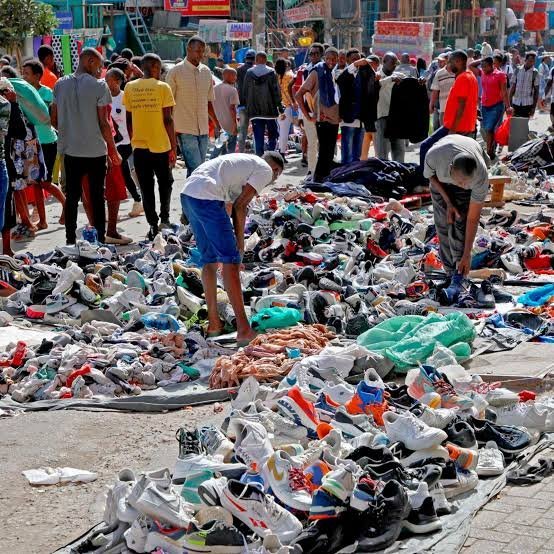
KIGALI — In 2015, six East African Community governments agreed on something rare in regional trade policy: a shared timeline to stop being a destination market for clothes other countries no longer wanted, and to build textile industries of their own instead. By 2019, when that phase-out was supposed to be complete, only one of the six was still standing behind it.
The United States made sure of that. When Rwanda raised its tariffs on secondhand clothing imports, from $0.20 per kilogram in 2016 to $2.50 the following year and $4 the year after, Washington didn't treat it as a domestic tax policy. It treated it as a breach of AGOA's free-market terms, suspended Rwanda's duty-free apparel access to the US market in 2018, and later imposed a 30% tariff on Rwandan clothing exports for good measure. Kenya, Uganda, Tanzania and Burundi watched that happen and reversed their own tariff plans rather than risk the same treatment.
Rwanda didn't reverse. That decision, and what it cost, is the more instructive story than the shorthand version usually told.
What Standing Firm Actually Bought
The tariff escalation worked exactly as intended on its own terms. Rwanda's trade ministry data shows secondhand clothing's share of the country's garment and textile imports falling from between 26% and 32% before the increases to between 2% and 7% afterward, one of the most decisive shifts any African country has produced against a trade its government judged to be undermining its own industrial base. President Paul Kagame has been direct about why Rwanda was willing to accept the consequences that came with it, arguing publicly that countries with oil or mineral wealth to fall back on face far less pressure to fall in line with Western trade conditions than countries without it, a pointed observation about how selectively that leverage gets applied across the continent. Rwanda's own Minister of Trade and Industry, Prudence Sebahizi, put it even more plainly in 2025: "industrial policy takes precedence over AGOA opportunities."
Losing AGOA access did not sink Rwanda's textile sector. It redirected it. Rwanda's garment and textile export revenue grew 83% in value between 2018 and 2020 alone, from $5.9 million to $34.6 million, with growth flowing toward the Democratic Republic of Congo, Belgium, Germany and Hong Kong rather than the US market the suspension had closed. C&H Garment Factory, the Kigali Special Economic Zone plant that had been Rwanda's largest apparel exporter to the US before the suspension, was acquired by Hong Kong-based Pink Mango C&D and rebuilt its customer base across Belgium, Germany, Spain, the UK, Turkey, France and the Czech Republic instead, evidence that a market closed by political pressure can be replaced rather than simply absorbed as a loss. Rwanda's oldest domestic garment manufacturer, Utexrwa, has separately reported domestic demand for locally made clothing rising 10-20% since 2018, a sign that at least some of the shift in supply found a matching shift in what Rwandan consumers were willing to buy.
The Rest of the Region Chose Differently
Kenya's position makes the contrast sharpest. Its own mitumba imports rose 76% between 2013 and 2022, and by the time the regional 2019 deadline arrived, it was importing more secondhand clothing than any other country on the continent, roughly $340 million in AGOA-eligible apparel exports of its own on the line if it followed Rwanda's path. Uganda, Tanzania and Burundi made similar calculations. All four abandoned the shared pledge specifically to preserve US market access, choosing continued dependence on imported used clothing over the near-term economic pain Rwanda absorbed.
That gap matters beyond one policy dispute. It's a live illustration of how much harder it is for a country dependent on a single external market to say no to that market's terms, even when its own government has identified the trade as working against its stated development goals. Rwanda's smaller US apparel exposure gave it more room to make the harder choice; it does not mean the choice was costless, and it should not be mistaken for evidence that Rwanda's path is simple for others to replicate.
The Part That's Still Unfinished
None of this makes Rwanda's policy a completed success story, and treating it as one would undersell how difficult even a determined, sustained effort has been. Rwanda's shared EAC customs union with Uganda gave the mitumba trade a route it never fully closed, Uganda has continued importing secondhand clothing at scale and re-exporting a portion across the border, and Rwanda still recorded an estimated $664,000 in worn clothing imports as recently as 2023, alongside informal smuggling significant enough that Rwandan police continue periodically posting photos of impounded clothing bales. Domestic factories still supply only about 5% of the clothing Rwandans actually wear today, well short of the government's own target.
That target, set under Rwanda's current National Strategy for Transformation, is 100% domestically made clothing supply by 2029, a genuinely ambitious goal that would require the pace of growth seen between 2018 and 2020 to continue for most of a decade. Whether Rwanda gets there on schedule is an open question. What is not in question is that it is the only country in the region that has spent nine years actually trying, absorbing a trade suspension and a 30% tariff along the way rather than treating those consequences as reason enough to stop.
Why This Matters Beyond Rwanda
The broader pattern this episode exposes is worth stating plainly. A regional bloc of six countries agreed collectively that they did not want to remain a market for clothing other economies had already discarded. One external actor's trade leverage was enough to unwind five of those six commitments within three years. The country that held out did so not because it had an easier path, but because it decided the alternative, permanent dependence on imports it had itself identified as blocking its own industrial development, was the worse outcome. That is a decision every developing economy weighing similar trade-offs will eventually have to make for itself, and Rwanda's experience is the clearest evidence yet of both what it costs to make it and what it can actually buy.
FAQ
Did Rwanda eliminate secondhand clothing imports entirely? Nearly, but not completely. Tariffs cut mitumba's share of garment imports from roughly 30% to under 7%, but leakage through Uganda's shared customs border meant Rwanda still recorded around $664,000 in used clothing imports as recently as 2023.
What did the United States do in response to Rwanda's tariffs? It suspended Rwanda's duty-free apparel access under AGOA in 2018 and later imposed a 30% tariff on Rwandan clothing exports, treating the tariff increase as a breach of AGOA's free-market conditions.
Why did Kenya, Uganda, Tanzania and Burundi abandon the same policy? Their exposure to the US apparel market was larger, Kenya alone had roughly $340 million in AGOA-eligible apparel exports at stake, and each government judged the near-term cost of losing that access too high to sustain.
Did losing AGOA actually hurt Rwanda's textile industry? Not in the way losing a major market usually does. Rwanda's garment and textile export revenue grew 83% between 2018 and 2020, as manufacturers redirected sales toward the DRC, Belgium, Germany and Hong Kong.
How much of Rwanda's clothing is made domestically today? About 5%, with the government targeting 100% domestic supply by 2029 under its current National Strategy for Transformation.
Is Rwanda's approach something other African countries could realistically copy? It's genuinely difficult to replicate. Rwanda's smaller US apparel exposure gave its government more room to absorb the consequences than larger exporters like Kenya have had, meaning the same policy would carry a steeper near-term cost elsewhere in the region.